Published Jun 24, 2026 · Last updated August 4, 2026 · 8 min read
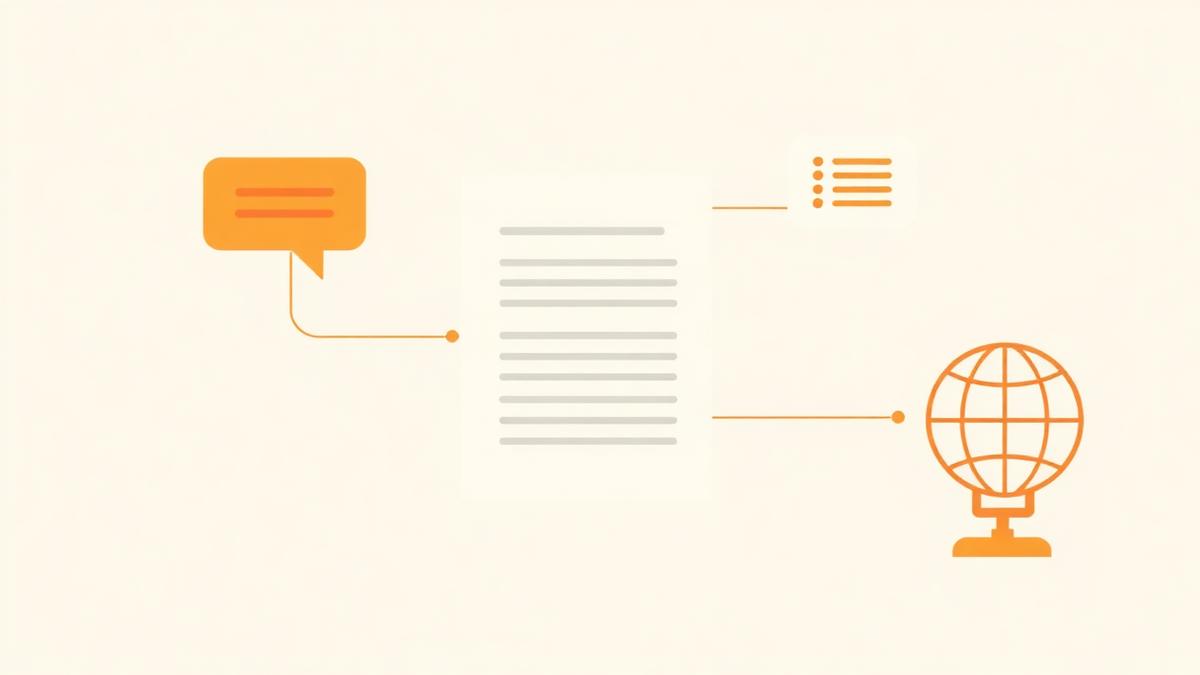
Every document tool is adding AI right now, and most of it is decoration. This post sets out what we think AI genuinely improves in document work, what it does not, and the rules we are holding ourselves to as we build the features on the PDFCraft roadmap.
Why this matters
Documents are where organisations store their obligations. A lease, a policy schedule, a set of tender conditions — these are long, dense and consequential. Reading them properly takes time most people do not have, so they skim, and skimming is where mistakes happen.
That is a real problem worth solving. Rotating a scanned page is not. Knowing the difference is the whole point.
Where AI genuinely helps
Question answering
The obvious case: open a 90-page contract and ask what the termination notice period is. A good answer includes the page reference so you can verify it yourself in ten seconds rather than reading for an hour.
Summarisation with structure
Less obvious, and arguably more useful: generating an outline of a long document with page links. Long PDFs are hard to navigate, and a reliable table of contents solves a boring problem that affects every single reader.
Translation of a page, not a paragraph
Translating an official letter is common and stressful. The value is in keeping the layout intact so the translated version still reads like the document it came from.
Extraction into a table
Pulling dates, amounts and party names out of a stack of invoices into rows is exactly the kind of tedious, error-prone work a model handles well — provided every extracted value can be traced back to the page it came from.
Where AI does not help
- Merging, splitting and rotating pages. These are deterministic operations that already take one click in the toolkit.
- Compression. This is arithmetic, not judgement.
- Placing a stamp or signature. You know where it goes; a model guessing is worse than you deciding.
- Anything where a wrong answer looks exactly like a right one and nobody will check.
The privacy problem, stated honestly
Our current tools are local. Your file is opened by your browser, changed in memory and written back to your device. That is a strong guarantee precisely because there is nothing to promise — no server ever sees the document.
Large language models are different. Running a capable model usually means sending text somewhere. We are not going to pretend otherwise, and we are not going to quietly change the privacy characteristics of the site because a feature is fashionable.
The rules we are committing to
- Local tools stay local. Nothing that works in your browser today will start uploading tomorrow.
- Anything that needs a model will say so on the page, before it runs, in plain language.
- AI features are opt-in. You will never trigger one by clicking a familiar button.
- Answers cite pages. If a feature makes a claim about your document, it will point at where it found it.
- No silent scope creep. If what we send changes, the page text changes with it.
Common use cases we hear about
| Scenario | What people want | Realistic expectation |
|---|---|---|
| Reviewing a lease | Find notice periods and break clauses | A pointer to the right clause, verified by you |
| Processing invoices | Extract dates and totals into a table | Accurate on clean documents, needs checking on poor scans |
| Studying a long report | A structured outline with page links | Reliable, and genuinely time-saving |
| Reading a foreign letter | A readable translation | Good for comprehension, not for official submission |
Common mistakes with AI document tools
- Pasting confidential text into a general chatbot without checking the retention terms.
- Accepting a summary as a substitute for reading a clause you are about to be bound by.
- Using extraction on low-quality scans without spot-checking the output.
- Assuming a translated document is legally equivalent to the original.
What you can do today
While the AI features are still in development, the mechanical work is already handled. Prepare documents properly and they will be far easier to work with later: merge related files, remove blank pages, fix sideways scans, and keep filenames consistent. Our document filing guide covers a system that takes minutes to adopt.
Summary
AI belongs in document work where reading is the bottleneck — questions, outlines, translation and extraction — and nowhere else. We will ship those features when they are accurate enough to be trusted, label them clearly, keep them optional, and leave the local tools exactly as local as they are today.
Frequently asked questions
- When will Chat with PDF be available on PDFCraft?
- It is on the roadmap and marked Coming Soon in the toolkit. We have not announced a date, because we would rather ship it accurate than early.
- Will AI features be free?
- The existing local tools will remain free. Model-backed features have a real running cost, so some may eventually sit behind an optional paid plan. Nothing changes without it being stated clearly on the page.
- Will my documents be uploaded when I use an AI feature?
- Features that need a model require text to be sent for processing. Every such feature will say so before it runs, and it will always be opt-in.
- Do the current PDF tools use AI?
- No. Merging, splitting, rotating, compressing, watermarking, stamping, signing and image conversion are deterministic operations that run entirely in your browser.
- Can AI replace reading a contract?
- No. Use it to locate the relevant clause quickly, then read that clause yourself. For anything legally binding, professional advice still matters.
- How accurate is AI extraction from scanned documents?
- Accuracy tracks scan quality. Clean digital documents extract reliably; faded or skewed scans need spot-checking against the source page.
The mechanical work is ready today — the AI tools will join the same free, clearly labelled toolkit.
See the current toolkitAbout this article
- Written by
- PDFCraft Team
- Reviewed by
- PDFCraft Editorial Team
- Last updated
PDFCraft builds free, browser-based PDF tools. This guide reflects how our team works with documents day to day and is reviewed whenever the underlying tools change.