


Published May 30, 2026 · Last updated August 4, 2026 · 8 min read
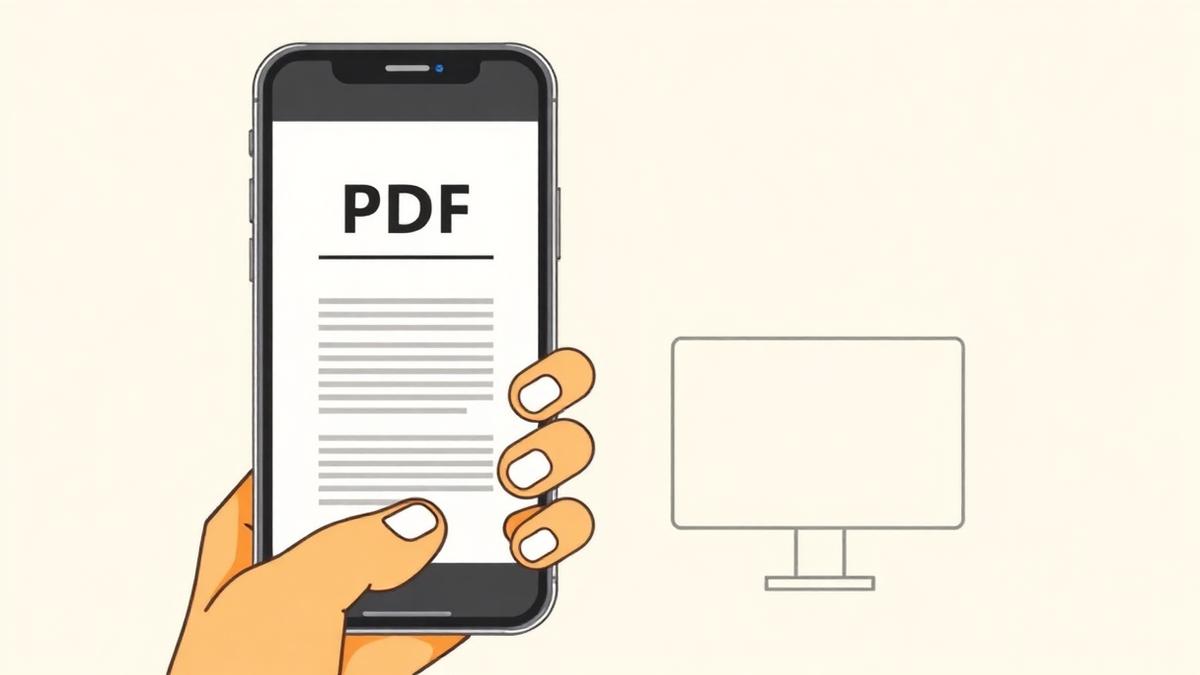
Most document tools were designed for a mouse and then squeezed onto a phone. Drag handles end up smaller than a fingertip, dialogs run off the bottom of the screen, and the file picker forgets that photos are files too. Editing a PDF on a phone should not feel like a workaround — for a lot of people, the phone is the only device they have.
Why mobile-first matters for documents
The documents people need to handle urgently usually arrive on a phone: an emailed contract, a scanned form from a government portal, a photo of a receipt. If the tool only works properly on a laptop, the task waits — and often gets done badly later.
There is also a capability gap. A phone has less memory and a slower single-core budget than a desktop, so a tool that renders every page of a 200-page document at full resolution will simply crash. Designing for the phone first forces the engineering to be efficient for everyone.
What changes when you design for touch
Target size
A fingertip covers roughly 9 mm. Controls smaller than that produce mis-taps, and mis-taps in an editor mean accidentally moving an object you had just positioned. Handles, buttons and toggles have to be sized for thumbs, not cursors.
Sheets instead of modals
Centre-screen dialogs are a desktop convention. On a phone, a bottom sheet sits within thumb reach, can be dismissed with a swipe, and leaves the document visible behind it.
Gestures people already know
Pinch to zoom, drag to move, two-finger pan. Reusing the gestures from the photo app means there is nothing new to learn.
A visible performance budget
Previews need to be cheap: render the visible page at screen resolution, generate thumbnails lazily, and only produce full-quality output at export time.
Common mobile PDF tasks
| Task | Why it happens on a phone | Tool |
|---|---|---|
| Signing an emailed agreement | The email arrived on the phone | Sign PDF |
| Turning receipt photos into one file | The photos are already on the camera roll | JPG to PDF |
| Fixing a sideways scan | Scanner apps often rotate pages | Rotate PDF |
| Shrinking a file to send | Mobile data limits and attachment caps | Compress PDF |
| Removing a page before sharing | A cover sheet or private page | Delete PDF Pages |
Step by step: editing a PDF on a phone
- Save the PDF from your email or messaging app to your device first — editing directly from a preview window often fails.
- Open the tool you need and add the file through the picker or by sharing it into the browser.
- Rotate the screen to landscape for page-level work; it roughly doubles the usable width.
- Pinch to zoom to the area you are editing before you place or resize anything.
- Use the undo control freely — it is faster than trying to nudge an element back into place.
- Export, then open the downloaded file in a viewer to confirm the result before you send it.
Real-world examples
Expense claims from the road
Photographing receipts as you go and converting them into a single PDF at the end of the week beats sorting a shoebox later. Image order and rotation matter more than resolution here.
A form that has to go back today
Download, sign, date-stamp and reply — entirely on the phone, in a few minutes, without forwarding the document to a laptop or a third-party server.
Common mistakes on mobile
- Working from a mail app preview rather than a saved file, so the export has nowhere to go.
- Trying to place a small element while zoomed out, then fighting to correct it.
- Loading a very large scanned document on an older phone with several other tabs open.
- Forgetting that the downloaded file goes to the Files or Downloads app, then assuming the export failed.
- Compressing a document twice because the first result was not checked.
Best practices
- Save files locally before editing, and use a consistent naming pattern.
- Do page-level work (rotate, delete, reorder) before detail work (stamps, signatures).
- Use landscape orientation for anything involving thumbnails.
- Verify the export in a viewer, especially the page you edited.
- Keep the original on the device until the recipient confirms receipt.
Summary
Mobile PDF editing works when the interface is built for thumbs and the rendering is built for limited memory. Save the file first, zoom before you place, work page-level to detail-level, and check the export. Done that way, a phone handles most document tasks as comfortably as a laptop.
Frequently asked questions
- Can I edit a PDF on my phone without installing an app?
- Yes. Browser-based tools run inside your mobile browser, so there is nothing to install and nothing to grant storage permissions to beyond the file you pick.
- Why does my phone struggle with large PDFs?
- Rendering pages consumes memory, and phones have far less of it than desktops. Closing other tabs, or splitting a very large document into parts, usually resolves it.
- Where do downloaded files go on a phone?
- On Android they appear in the Downloads folder or the Files app; on iOS they are saved to Files, usually under Downloads. The export has not failed if you cannot see it in the browser.
- Is editing on mobile as accurate as on desktop?
- It can be, if you zoom in before positioning elements. Touch precision at full zoom is comparable to a mouse at a smaller zoom level.
- Can I merge several PDFs on a phone?
- Yes. Add the files, drag the cards into the order you want, and export the combined document.
- Do mobile browsers support drag and drop reordering?
- Yes — touch drag is supported throughout the toolkit, with targets sized for fingertips rather than cursors.
Every PDFCraft tool is built mobile-first — open this page on your phone and test the one you need.
Try the tools on your phoneAbout this article
- Written by
- PDFCraft Team
- Reviewed by
- PDFCraft Editorial Team
- Last updated
PDFCraft builds free, browser-based PDF tools. This guide reflects how our team works with documents day to day and is reviewed whenever the underlying tools change.