Published Jul 3, 2026 · Last updated August 4, 2026 · 11 min read
A PDF that will not upload is one of the most common document problems there is. An application portal rejects the file, an email bounces back, or a form silently refuses a scan that is a few hundred kilobytes over the limit. The instinct is to compress as hard as possible and hope the result is still readable — but with a little understanding of why the file is large, you can usually get under the limit and keep the document looking exactly as it should.
This guide explains what actually makes PDFs heavy, how compression works, what to expect when you need a file under a specific size such as 100KB, 300KB or 1MB, and how to prepare documents for online applications, email and scanned paperwork.
Why PDF files become too large
Most oversized PDFs are not large because of what they say. They are large because of how they were produced. Once you can recognise the cause, you can predict how much room there is to shrink the file.
- High-resolution images: photos and screenshots embedded at full size, then visually scaled down on the page. The page looks small; the data behind it is not.
- Scanned documents: every page is stored as a picture. A colour scan at 600 DPI can be twenty times heavier than the same page scanned sensibly.
- Embedded fonts: complete font families are bundled in, sometimes more than once when a document is assembled from several sources.
- Unnecessary metadata: titles, author fields, producer strings, revision history and hidden layers that nobody will ever read.
- Duplicate objects: the same logo or header image stored separately on every page instead of once.
- Uncompressed object streams: some exporters prioritise speed and skip the structural compression the PDF format already supports.
- Other embedded resources: attachments, form scripts, colour profiles and thumbnails that survive from earlier versions of the file.
A 30MB colour scan has enormous slack in it. A 300KB invoice generated by accounting software is already close to optimal and will barely move — and that is the correct outcome, not a failed compression.
How to compress a PDF without losing quality
Compression comes in two broad kinds, and the difference decides whether your document changes visually.
Lossless optimisation
Lossless work changes the file's plumbing, not its appearance: removing metadata, discarding duplicated resources and rewriting the internal structure into compressed object streams. Text stays crisp, images keep every pixel, and the rendered page is identical. This is what "without losing quality" really means, and it should always be your first attempt.
Lossy optimisation
Lossy work downsamples and re-encodes images, permanently discarding pixels. It produces the dramatic reductions people associate with compression, and it is a reasonable trade for a screen-only copy of a scan. It is the wrong choice for anything heading to a professional printer, and it cannot be undone.
Why different documents behave differently
Text-based PDFs — invoices, letters, exported reports — are mostly vector instructions and are usually small to begin with. Image-heavy PDFs and scans are dominated by pixel data, so they hold most of the potential savings. That is why one person compresses a file by 80% and another sees 3%: they are compressing very different documents.
Choosing a compression level
Work upwards, not downwards. Start with the lightest setting, look at the resulting size, and only step up if you are still above the limit you need to meet. The smallest possible file is rarely the best result — a document that is unreadable, or a scan whose reference numbers have gone soft, has failed at its actual job. The goal is simple: get under the required limit while the document stays readable and usable.
How much can a PDF actually be compressed?
There is no universal ratio, and any tool that promises one is guessing. The realistic outcome depends on the original file size, the number of pages, the resolution of embedded images, whether the content is scanned, how fonts are embedded, what other resources are attached, and which compression method is applied.
As a rough guide: heavily scanned bundles have the most to give, mixed documents with a few large screenshots often shrink noticeably from structural optimisation alone, and clean text documents may change by only a few percent. Judge the result by whether it fits your limit and still reads well, not by the percentage.
Compressing a PDF to a target size
Most people searching for compression are not chasing a percentage — they need a file under a specific number because a system on the other side says so. Common cases include government forms, job applications, university and college admission portals, visa and document submissions, online forms with fixed attachment caps, internal document portals, and email systems that reject oversized attachments.
Whether a specific target is reachable depends entirely on the source document. A one-page text form can drop under 100KB comfortably; a forty-page colour scan cannot, no matter which tool you use, without reducing image quality to the point of unreadability. Treat the numbers below as guidance, not guarantees.
| Target size | Common use case | Recommended approach |
|---|---|---|
| 100KB | Small online uploads and strict form limits | Strong compression may be required; reduce page count and scan resolution first |
| 200KB | Forms and document portals | Balance size and readability; check small print afterwards |
| 250KB | Application and document uploads | Use an appropriate level, then verify text clarity |
| 300KB | Online applications and admission forms | Balance quality and size; remove unnecessary pages |
| 500KB | General uploads and shared documents | Moderate compression may be enough |
| 1MB | Email attachments and larger portals | Moderate compression is often sufficient |
Compress PDF to 100KB
A 100KB cap usually appears on older government forms and lightweight upload widgets. It is a demanding target: 100KB is roughly the size of a single ordinary photograph, so a document that includes scans will need genuinely aggressive treatment to fit. If you need to reduce a PDF to 100KB, remove every page that is not required, rescan in grayscale at a lower resolution if you still have the paper, and then compress. If the result is unreadable, the honest answer is that the document needs to be split rather than crushed.
Compress PDF to 200KB
200KB is a common limit for identity documents, certificates and short supporting files. Single-page and two-page documents reach it fairly often. The main risk at this level is scanned text going soft, so open the compressed copy and confirm that names, dates and reference numbers are still clearly legible before you submit it.
Compress PDF to 250KB
Some application portals settle on 250KB for uploads such as transcripts, experience letters and photo pages. It is slightly more forgiving than 200KB and often achievable for a short scanned document. Compress once from the original file rather than repeatedly compressing an already reduced copy.
Compress PDF to 300KB
300KB is a frequent limit on online application systems that expect a few pages rather than a full dossier. For a three or four page scan this is usually within reach. If you are slightly over, deleting a redundant cover sheet or blank scanned page is often enough on its own.
Compress PDF to 500KB
500KB tends to be the sweet spot: large enough to keep scanned pages comfortably readable, small enough for almost any upload form. When a portal allows it, aim here rather than pushing further — extra compression below your limit buys you nothing.
Compress PDF to 1MB
1MB is typical of larger document portals and is generous for email. Moderate compression is often sufficient, and many multi-page documents get there through structural optimisation alone, with no visible change at all. If you need a PDF under 1MB and it contains long scanned appendices, consider sending the core document and splitting the appendices into a second file.
How to compress a PDF for an online application
The problem is always phrased the same way: the portal says the PDF is too large. Job applications, government services, university and college admissions, visa submissions and internal HR systems all enforce attachment caps, and they rarely explain how to meet them.
Start by reading the requirement carefully. Most portals state both a maximum size and an accepted format, and some also cap the number of pages. Knowing the exact limit tells you how far you need to go — reducing PDF size for an online application is much easier when you are not aiming blindly at "as small as possible".
Then reduce what you can without touching quality. Remove pages the application does not ask for using Delete PDF Pages, put multi-part documents in the right order with Rearrange PDF Pages, and only then compress. For a job application, a two-page CV rarely needs anything beyond light optimisation. For a government application with scanned certificates, expect to compress harder and to check legibility afterwards.
If a portal asks for separate documents rather than one bundle, Split PDF will divide the file, which frequently solves an upload problem better than compression does.
How to compress a PDF for email
Email is the second place people meet a hard limit. Attachment caps vary between providers and between corporate mail servers, so check the limit that applies to you rather than assuming a number — a message that is fine internally can be rejected by the recipient's server.
To make a PDF smaller for email, compress the original once, confirm it opens correctly, and attach the compressed copy under a distinct filename so you keep the full-quality version. Scanned documents are the usual offenders and respond best to stronger settings, because on-screen reading tolerates softer images than printing does.
If a document is still too large for email after reasonable compression, split it into logical parts and send them separately, or share a link instead. Sending three readable files is better than one unreadable one.
How to reduce the size of a scanned PDF
Scanned PDFs are large because each page is a photograph rather than text. Three factors dominate the size.
- Resolution: 600 DPI captures far more detail than a printed page contains. 200–300 DPI is enough for ordinary documents and is dramatically lighter.
- Colour mode: colour scans of black-and-white paperwork are wasteful. Grayscale, or black and white for plain text, cuts the data substantially.
- Page count: every extra scanned page adds a full image. Removing blank backs and separator sheets is free size reduction.
If you still have the paper original, rescanning with better settings will beat any amount of after-the-fact compression. If you only have the file, compress it and then read it critically — reference numbers, signatures and small print are where degradation shows first.
One caveat worth knowing: a scan contains no real text unless it has been through OCR. Compression does not remove searchable text if it exists, but it will not create it either, so if you need to search or copy from the document, handle OCR before you start reducing the file.
How to keep PDF quality while compressing
Quality is not one thing. Text readability, image clarity and print output each fail at different points, so decide which of them matters for this particular copy.
- Text in a digital PDF is stored as vector instructions and stays sharp at any compression level — only images are resampled.
- Scanned text is an image, so it is the first thing to suffer. Zoom to 100% and check the smallest print in the document.
- For anything going to a printer, use the lightest setting or skip compression entirely; print reveals downsampling far more than a screen does.
- Compare the original and compressed sizes before downloading. If the saving is small, the heavier file is usually the better choice.
- Never compress an already compressed copy. Go back to the original and apply a stronger setting once.
How to compress a PDF online with PDFCraft
- Open PDFCraft's Compress PDF tool.
- Select the PDF, or drag and drop it onto the upload area.
- Choose a compression level: Low for light optimisation and best quality, Medium for a balance of size and quality, or High for the smallest file, which also strips document metadata.
- Select Compress PDF and watch the progress indicator while the file is rewritten.
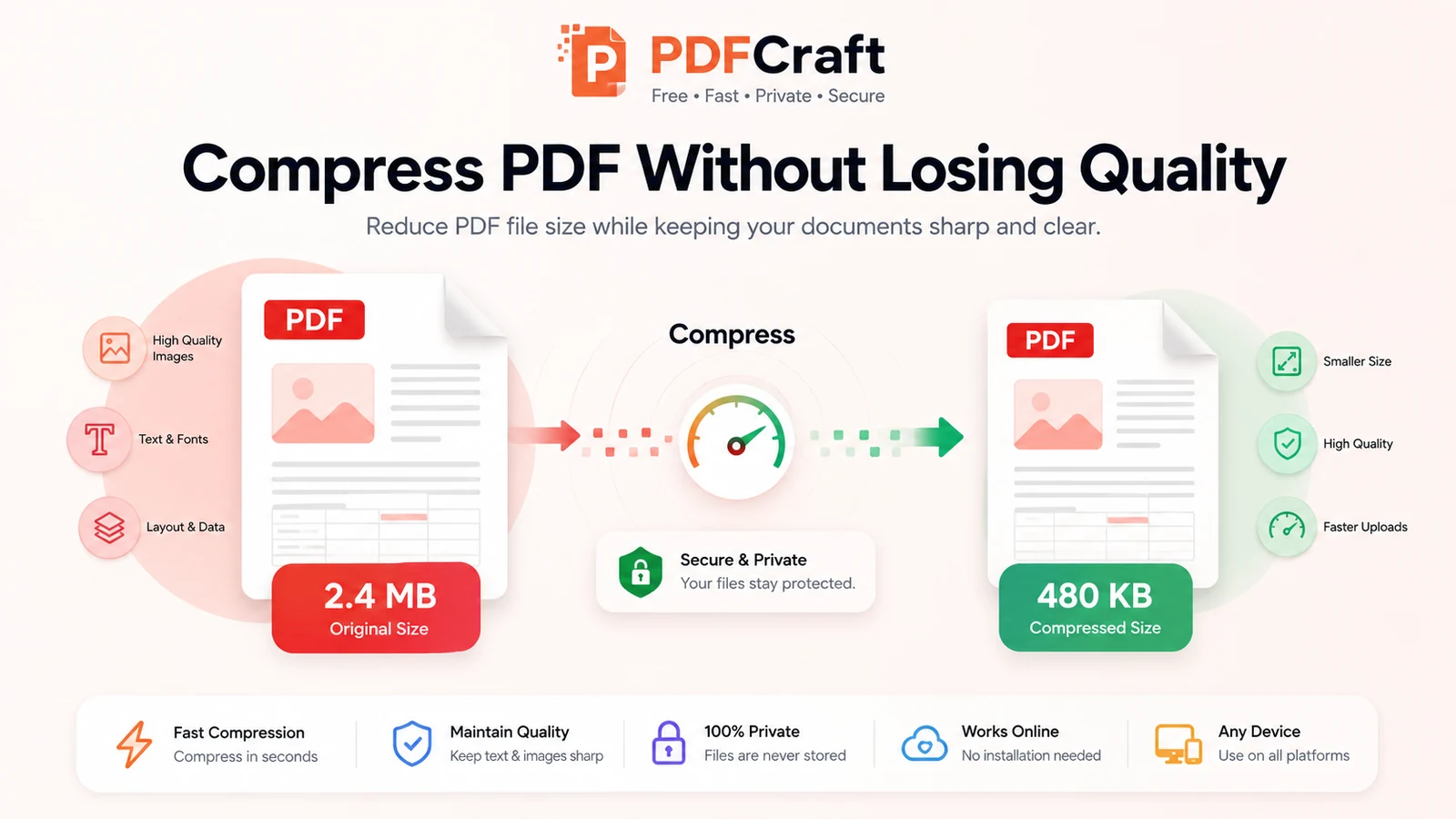
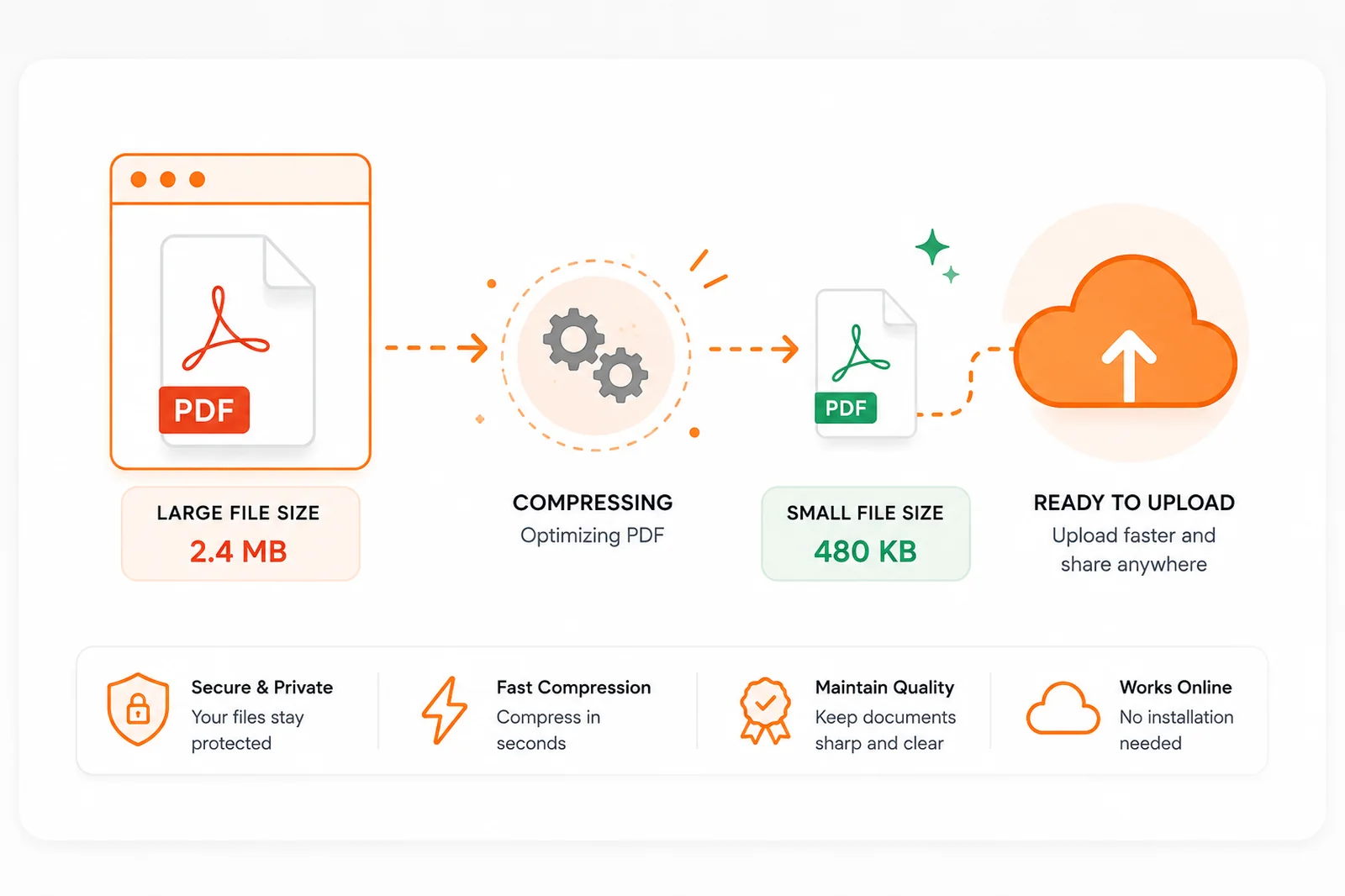
- Review the result panel, which shows the original size, the compressed size and the percentage saved.
- Compare the two figures against the limit you need to meet, and try a stronger level if you are still above it.
- Download the compressed PDF and open it to confirm the pages you care about still look right.
PDFCraft's compressor works by rewriting the document's internal structure into compressed object streams and, at Medium and High, removing embedded metadata such as title, author and producer fields. It runs entirely in your browser, so files are never uploaded to a server — which is what makes it suitable for confidential or personal paperwork. It does not resample images and does not accept a target-size value, so results vary with the source document.
PDF compression tips
- Check the required upload limit first, so you know when to stop.
- Remove unnecessary pages before compressing with Delete PDF Pages — fewer pages is the cleanest possible saving.
- Scan at a sensible resolution rather than the highest one your scanner offers.
- Combine related documents once with Merge PDF so shared resources are stored a single time.
- Straighten sideways scans using Rotate PDF before compressing, so you only process the file once.
- Apply any watermark or stamp before compression, not after.
- If you only need a page as an image, exporting with PDF to JPG can be smaller than a PDF.
- Keep the original file as a backup, and name the compressed copy distinctly.
- Check readability after compression, not just the file size.
- Use the strongest setting only when a limit genuinely requires it.
For a shorter walkthrough of the tool itself, see the step-by-step how-to guides, or read our overview of browser-based document processing if you want to understand why local compression is faster than uploading.
Summary
Good compression is a decision rather than a button. Work out why your file is large, start with the least destructive option, step up only as far as your limit demands, check the pages that matter, and keep the original. Do that and "my PDF is too large" stops being a problem worth worrying about.
Frequently asked questions
- How do I reduce a PDF to 100KB?
- Strip the document back before compressing: delete pages the recipient does not need, and if the file is a scan, rescan in grayscale at 200–300 DPI. Then compress from the original. 100KB is a demanding target and is realistic mainly for short, mostly-textual documents.
- How can I compress a PDF to 200KB?
- Short documents of one or two pages often reach 200KB. Compress once from the original file, then open the result and confirm names, dates and reference numbers are still clearly legible before submitting it.
- How do I compress a PDF to 250KB?
- Reduce the page count to exactly what is requested, then apply a moderate compression level and check the reported output size. If you are close but over, removing a cover sheet or blank scanned page is usually enough.
- How can I compress a PDF to 300KB?
- A three or four page scan will often fit under 300KB. Compress the original rather than a previously compressed copy, and step up the compression level only if the first result is still above the limit.
- How do I compress a PDF to 500KB?
- 500KB is comfortably reachable for most multi-page documents and leaves scanned text clearly readable. Use a moderate level and stop as soon as the file is under the limit — extra compression below the requirement gains you nothing.
- How do I reduce a PDF to 1MB?
- Many documents get under 1MB through structural optimisation alone, with no visible change. If long scanned appendices keep the file above 1MB, splitting them into a second document is usually better than compressing harder.
- How can I compress a PDF without losing quality?
- Use the lightest setting first. Removing metadata and rewriting the document's internal structure reduces size without altering how a single page looks. Only move to stronger settings when a size limit forces you to.
- Can I compress a scanned PDF?
- Yes, and scans usually have the most to gain because each page is an image. Expect a visible trade-off at strong settings, and check the smallest print in the document before you send it.
- How do I compress a PDF for an online application?
- Read the portal's stated size limit, remove any pages the application does not ask for, compress the file, and verify it is under the limit and still readable. If separate documents are requested, splitting the file often solves the problem better than compression.
- How do I make a PDF smaller for email?
- Compress the original once, keep the full-quality version, and attach the smaller copy. If it is still too large for your mail server, split the document into parts or share a link instead.
- Why is my PDF still large after compression?
- Because it was already efficient, or because its size comes from high-resolution scanned images that structural optimisation cannot change. Documents exported by modern software often use compressed streams already, leaving little to remove.
- Can every PDF be reduced to an exact size?
- No. Final size depends on the original file, page count, image resolution, scanned content, embedded fonts and other resources. PDFCraft's compressor does not take a target-size value, so treat specific numbers as goals to check against rather than guarantees.
Need to compress a PDF? PDFCraft's compressor runs in your browser, shows the original and compressed sizes side by side, and lets you download the smaller file once you are happy with it.
Open Compress PDFAbout this article
- Written by
- PDFCraft Team
- Reviewed by
- PDFCraft Editorial Team
- Last updated
PDFCraft builds free, browser-based PDF tools. This guide reflects how our team works with documents day to day and is reviewed whenever the underlying tools change.