Last updated August 4, 2026 · 4 min read
Oversized PDFs are a daily annoyance. Mail servers reject attachments over a certain size, upload forms silently fail, and a 60 MB scan takes forever to open on a phone. Compression solves this by removing waste from the file — but it is worth understanding what is actually being removed, because that determines how much you can save and what it costs in quality.
This guide explains where PDF bloat comes from, how to choose a compression level, and how to check the result. The steps use the free Compress PDF tool, which works entirely in your browser.
Why PDFs get large in the first place
Scanned images
A scanned page is a photograph of paper. At 600 DPI in colour, one A4 page can be several megabytes, and twenty of them make a file no email will accept. Text-based PDFs exported from a word processor are typically a hundred times smaller for the same content.
Embedded fonts and duplicated objects
Documents assembled from several sources often carry the same font or the same logo embedded many times over, plus revision history and unused objects left behind by the software that produced them.
When should you compress a PDF?
- The file exceeds an email or upload limit.
- You are publishing a document for download and want it to open quickly.
- A scan is far larger than the content justifies.
- You are archiving many documents and storage adds up.
Do not compress a document that is already small, and do not compress a file that must retain maximum image fidelity — for example artwork proofs or documents used for legal image evidence.
Choosing a compression level
| Level | Best for | Trade-off |
|---|---|---|
| Low | Text documents and contracts you must keep pristine | Modest size reduction |
| Medium | Most everyday documents and mixed text-and-image reports | Good balance of size and clarity |
| High | Bulky scans for email, where readability matters more than detail | Images become visibly softer |
How to compress a PDF step by step
Step 1 — Upload and note the original size
Open the Compress PDF tool and add your file. The original size is displayed so you have a baseline to compare against.
Step 2 — Pick a level
Start with Medium. It is the right answer for the majority of documents; escalate to High only if the result is still too big.
Step 3 — Run the compression
Watch the progress indicator move through preparing, processing and finalising. Large scans take longer because there is more image data to work through.
Step 4 — Compare before and after
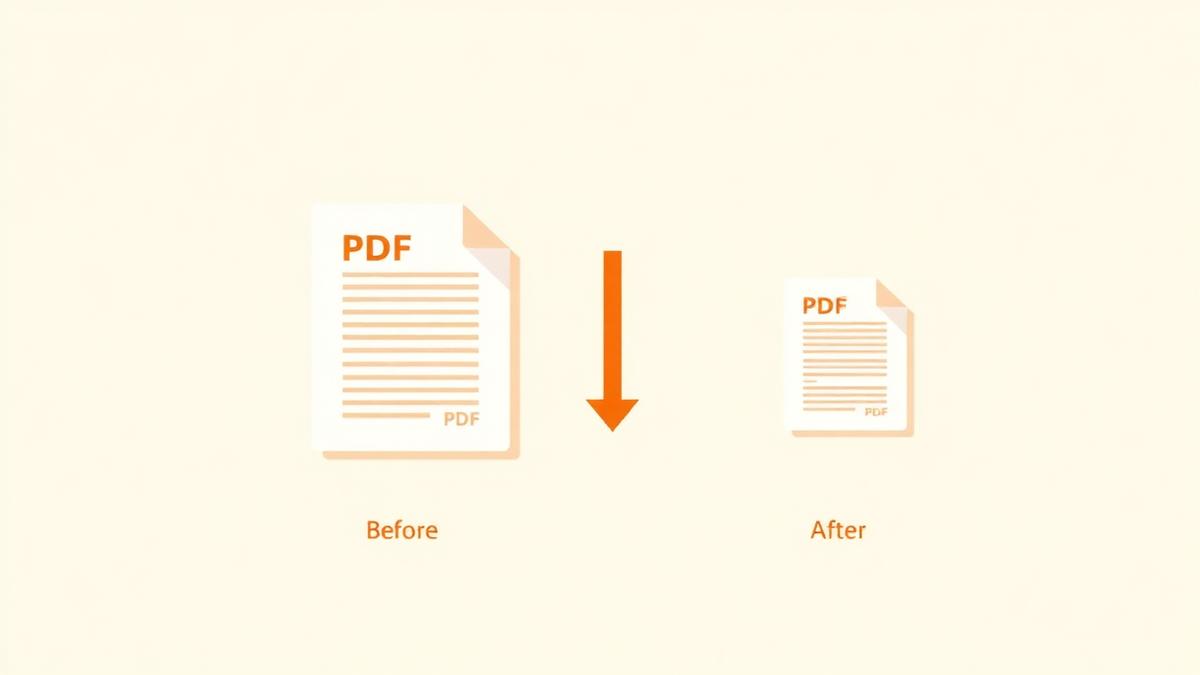
The tool shows both sizes. If the saving is small, the document was probably already efficient — mostly text with few images.
Step 5 — Check quality, then download
Open the compressed file and zoom to 100% on the busiest page. Look at small print, table rules and signatures. If they are clean, keep it; if not, redo at a gentler level.
Common mistakes
- Compressing repeatedly — each pass on the same images degrades quality further with diminishing returns.
- Expecting a text-only PDF to halve in size; there is little to remove.
- Choosing High for a document that will be printed at full size.
- Deleting the original before checking the compressed version.
Troubleshooting
| Problem | Likely cause | What to do |
|---|---|---|
| Barely any size reduction | The PDF is mostly text and already efficient | Reduce page count with Delete PDF Pages instead |
| Text looks soft after compression | The pages are scanned images, not real text | Recompress at a lower level from the original file |
| The browser struggles on a huge file | Limited memory on the device | Split the document first, compress the parts, then merge |
| Still too large for email | Very high-resolution scans | Rescan at 200-300 DPI in greyscale, or share via a link |
| Password prompt appears | The PDF is encrypted | Save an unprotected copy, then compress |
| The download never starts | Downloads are blocked for the site | Allow downloads in your browser settings and retry |
Best practices
- Always compress from the original, never from an already-compressed copy.
- Remove unnecessary pages before compressing — deleting beats squeezing.
- Scan at 200-300 DPI; higher resolutions rarely improve readability but always inflate the file.
- Keep an uncompressed master copy of anything contractual.
Security and privacy notes
Compression runs locally, so your document is never uploaded to a compression service. This matters because the files people most want to shrink — scanned passports, bank statements, medical reports — are exactly the ones that should not be sitting on an unknown server.
Summary
Upload, start at Medium, compare sizes, inspect the busiest page and download. For the underlying detail on what makes PDFs bloated, read compressing PDFs without losing quality, and see the merge guide if you are assembling a large document from parts.
Pro tip
Scanned documents benefit most; text-only PDFs are already close to optimal.
Frequently asked questions
- Will compression make my text blurry?
- Real text stays sharp because it is stored as vectors and font data. Blurriness only appears in scanned pages, which are images.
- How much smaller will my file get?
- It depends entirely on the content. Image-heavy scans often shrink dramatically; text-only documents may barely change.
- Can I compress the same PDF twice?
- You can, but each pass degrades images further while saving less. Always go back to the original instead.
- Is my file uploaded for compression?
- No. Everything happens inside your browser, so the document never leaves your device.
- Which level should I choose?
- Medium suits most documents. Use Low for anything that must stay pristine and High only when you need a big reduction for email.
- Why is my scanned PDF so large?
- Each page is a high-resolution photograph. Scanning in greyscale at 200-300 DPI produces far smaller files with no meaningful loss of readability.
- Does compression remove passwords or signatures?
- Encrypted files must be unlocked first. Digital signatures may be invalidated by any change to the file, including compression, so sign after compressing.
Shrink an oversized attachment in your browser and compare the before and after sizes instantly.
Open Compress PDFAbout this guide
- Written by
- PDFCraft Team
- Reviewed by
- PDFCraft Editorial Team
- Last updated
PDFCraft builds free, browser-based PDF tools. This guide reflects how our team works with documents day to day and is reviewed whenever the underlying tool changes.